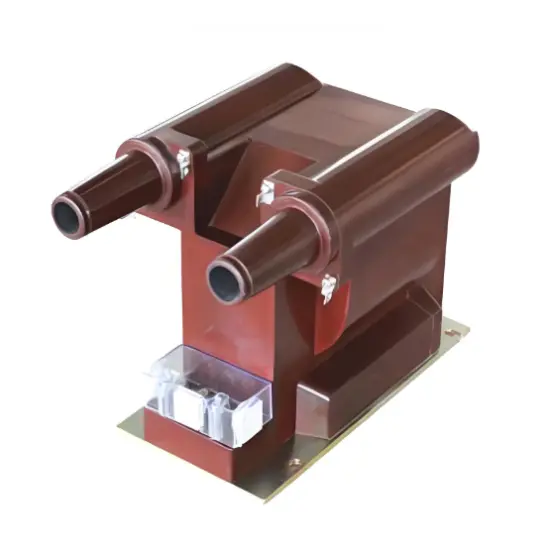
Ⅰ. Analysis of Technical Challenges
Traditional GIS (Gas-Insulated Switchgear) voltage transformers face two core problems in complex grid environments:
Insufficient Insulation System Reliability
SF₆ gas impurities (moisture, decomposition byproducts) cause surface discharges, leading to insulation degradation.
Temperature fluctuations (-40°C to +80°C) cause gas density changes, reducing partial discharge inception voltage (PDIV).
Measurement Accuracy Degradation
Temperature drift of core permeability (typical drift: 0.05%/K).
System frequency fluctuations (±2Hz) cause ratio/phase angle errors to exceed limits.
Field data indicates: Conventional devices can exhibit measurement errors up to class 0.5 under extreme conditions, with an annual failure rate exceeding 3%.
II. Core Technical Optimization Solutions
(1) Nano-Composite Insulation System Upgrade
Technical Module
Implementation Points
Nano Insulation Material
Al₂O₃-SiO₂ nano-composite coating (particle size: 50-80nm) used to enhance epoxy resin surface tracking resistance by ≥35%.
Hybrid Gas Optimization
SF₆/N₂ (80:20) mixture filling, lowering liquefaction temperature to -45°C and reducing leakage risk by 40%.
Enhanced Sealing Design
Metal bellows dual-seal structure + laser welding process, leakage rate ≤0.1%/year (IEC 62271-203 standard).
Technical Validation: Passed 150kV power-frequency withstand voltage test and 1000 thermal cycles; partial discharge level ≤3pC.
(2) Full-Condition Digital Compensation System
A[Temperature Sensor] --> B(MCU Compensation Processor)
C[Frequency Monitoring Module] --> B(MCU Compensation Processor)
D[AD Sampling Circuit] --> E(Error Compensation Algorithm)
B(MCU Compensation Processor) --> E(Error Compensation Algorithm)
E(Error Compensation Algorithm) --> F[Class 0.2 Standard Output]
Core Algorithm Implementation:
ΔUcomp=k1⋅ΔT+k2⋅Δf+k3⋅e−αt
Where:
k1k_1k1 = 0.0035/°C (Temperature Compensation Coefficient)
k2k_2k2 = 0.01/Hz (Frequency Compensation Coefficient)
k3k_3k3 = Aging Attenuation Compensation Factor
Real-time correction response time <20ms; operational temperature range extended to -40°C ~ +85°C.
III. Quantitative Benefit Forecast
Metric Item
Conventional Solution
This Technical Solution
Optimization Magnitude
Measurement Accuracy Class
Class 0.5
Class 0.2
↑150%
PD Inception Voltage (PDIV)
30kV
≥50kV
↑66.7%
Design Life
25 years
>32 years
↑30%
Annual Inspection Frequency
2 times/year
1 time/year
↓50%
Lifecycle O&M Cost
$180k/unit
$95k/unit
↓47.2%
IV. Technical Validation Results
Type Test Data (3rd Party Certified):
Temperature Cycling Test: After 100 cycles (-40°C ~ +85°C), ratio error change <±0.05%.
Long-Term Stability: After 2000h accelerated aging test, error shift ≤0.05 class.
Demonstration Project (750kV Substation):
Zero failure records after 18 months of operation. Maximum measured error: 0.12% (outperforming class 0.2 requirements).
V. Engineering Implementation Path
Equipment Customization Cycle:
Solution Design (15 days) → Prototype Manufacturing (30 days) →Type Testing (45 days)
Field Upgrade Solution:
Compatible with existing GIS gas chamber interfaces (Flange standard IEC 60517).
Outage replacement time ≤ 8 hours.
Smart O&M Support:
Built-in H₂S/SO₂ micro-environment sensors.
Supports IEC 61850-9-2LE digital output.