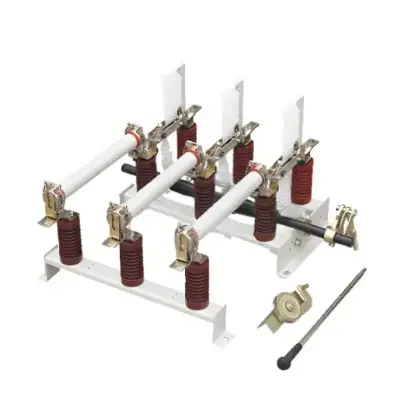
I. Pain Point Focus: Arc-Extinguishing Decay Mechanism and Arcing Incident Evidence
Core Problem: Arc-extinguishing performance is the heart of a vacuum load break switch (LBS). To control costs, some companies use inferior vacuum interrupters or substandard contact materials. This results in insufficient vacuum levels, leading to air leakage, contact wear, and incomplete arc extinction during long-term operation. When breaking load currents, persistent arcing can occur, burning components or even triggering phase-to-phase short circuits and power interruptions.
Typical Case: In a 12kV distribution network of an industrial park, over 30 low-cost vacuum LBS units used ordinary ceramic interrupters and copper alloy contacts. Arc-extinguishing performance began decaying just 2 years after commissioning. One unit, while breaking a 1250A load current, failed to extinguish the arc rapidly because the vacuum level had dropped below the 10-3Pa standard. The persistent arcing burned the contacts and insulation sleeves, causing a phase-to-phase short circuit. This resulted in a 6-hour outage for three production lines and direct economic losses exceeding 400,000 RMB. Post-incident inspection confirmed the cause was substandard interrupters and excessive contact wear.
II. Dual-Core Upgrade: Component Reinforcement × Full-Lifecycle Quality Control Loop
Focusing on the core pain point of arc-extinguishing decay and based on the case evidence, the following two-pronged approach eliminates arcing hazards and improves operational reliability:
Upgrade Core Arc-Extinguishing Components: Abandon ordinary ceramic interrupters in favor of high-performance ceramic vacuum interrupters, with vacuum levels strictly controlled below 10-4 Pa to eliminate leakage. Use silver-plated copper-chromium alloy contacts to enhance wear and arc-erosion resistance. Optimize contact structures to increase the contact area, preventing concentrated arc damage during breaking.
Strengthen Full-Process Quality Control: Interrupters must undergo specialized vacuum testing before leaving the factory to eliminate non-compliant products. Once commissioned, equip the units with vacuum monitoring sensors to track interrupter status in real-time. If the vacuum level drops to the threshold, an alarm is triggered immediately for timely component replacement, preventing arcing failures.
III. Empirical Results: Quantifying Industrial Park Transformation Benefits
12kV Vacuum LBS Transformation in an Industrial Park
Before: Used low-cost vacuum LBS with poor arc-extinguishing performance and poor contact. Averaged 4 faults per year with O&M costs of 80,000 RMB/year. An arcing fault previously caused production line outages and direct losses of over 400,000 RMB.
After: Deployed vacuum LBS optimized by this solution, featuring upgraded interrupters, contacts, and operating mechanisms alongside an intelligent monitoring system. In the first year post-transformation, zero faults occurred. Contact temperature rise remained stable below 60K, and vacuum levels met standards. O&M costs dropped to 30,000 RMB/year, completely resolving the pain points of arc-extinguishing and poor contact while ensuring production continuity.
IV. Conclusion: Fortifying the Arc-Extinguishing Barrier to Protect the Industrial Power Lifeline
Implementing this solution thoroughly resolves the problem of arc-extinguishing decay. Vacuum levels remain stable and compliant, contact wear rates are significantly reduced, and arcing phenomena during load current breaking are eliminated. This effectively prevents phase-to-phase short circuits and power interruptions, reduces economic losses as demonstrated in the case study, extends equipment lifespan, and lowers O&M costs.
Success Case Details:Three-Scenario Customization: Environmental Adaptability Upgrade for High-Altitude, Coastal, and Industrial Vacuum Load Break Switches-Rockwill