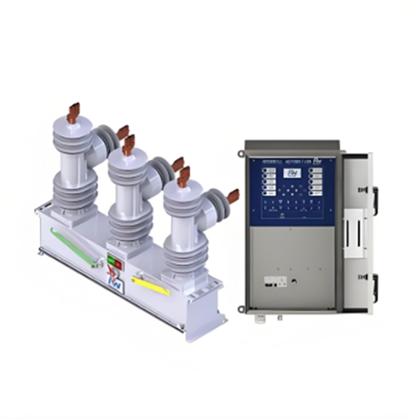
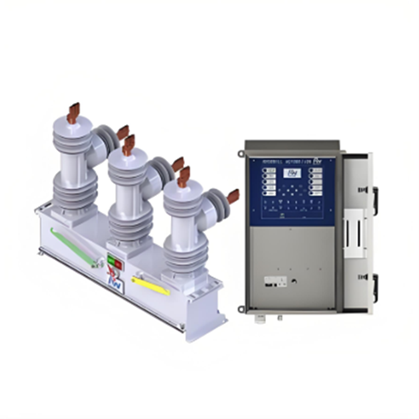
Ⅰ. Core Functional Positioning Differences 1. Recloser: Intelligent Self-Healing Switch
Essence: Integrates arc-extinguishing system, operating mechanism, and intelligent control unit. Capable of autonomous fault detection → tripping → time-delayed reclosing → locking.
Core Advantages:
Programmable Operation Sequences: Supports customizable sequences (e.g., "one fast + three delayed" or "two fast + two delayed") to distinguish transient/permanent faults. Example: First fast trip clears transient faults; subsequent delayed trips coordinate with fuses.
No External Control: Built-in current transformers (CTs) and microprocessors directly use line current for power, operating independently without relay protection panels.
2. Outdoor High Voltage Circuit Breaker: Basic Interruption Device
Essence: Solely tasked with short-circuit current interruption, relying on external relays for control logic.
Limitations:
Fixed operation sequences (e.g., "trip → 0.3s → close-trip → 180s → close-trip"), unable to adapt to complex distribution network protection.
Requires control cabinets and DC power sources, increasing system complexity and cost.
II. Core Advantages of Reclosers 1. High Integration & Intelligence
Self-Contained Control: Embedded current detection, logic judgment, and line-powered operation enable full automation, minimizing manual intervention.
Advanced Protection Algorithms:
Inverse-time characteristic curves precisely match fuse ampere-second characteristics for optimized coordination.
Optional zero-sequence CT modules enhance ground fault detection accuracy.
2. Leap in Power Supply Reliability
Multi-Reclosing Mechanism: 3–4 reclosing attempts (e.g., "one fast + three delayed") restore 80% of transient faults on first attempt.
Rapid Fault Isolation: With sectionalizers, locates and isolates faults in ≤30s, reducing outage scope by 70%+.
Backfeed Prevention: Tie recloser (QR0) delay-closing logic avoids reverse power flow during substation maintenance.
3. Cost Efficiency & Deployment
40% Lower TCO:
Eliminates relay protection panels, DC screens, and switchroom space.
Pole-mounted installation (200–300 lbs) vs. breakers requiring 1,800–3,000 lbs + concrete foundations.
3× Longer Maintenance Cycles:
Vacuum/SF₆ types endure 10,000 operations; maintenance every 3–5 years vs. frequent spring-mechanism repairs in breakers.
4. Extreme Environment Adaptability
Enhanced Weather Resistance:
Three-phase common tank (SF₆-insulated) tolerates -40°C to 40°C.
Epoxy-encapsulated split-phase design suits mines/coastal areas.
Topology Flexibility:
Single-phase units for rural branches; three-phase assemblies resolve neutral grounding issues.
III. Key Parameter Comparison
Characteristic
Recloser
Outdoor HV Circuit Breaker
Advantage
Rated Current
400–1200A (630A mainstream)
1200–3000A
More economical for light loads
Short-Circuit Breaking Capacity
≤16kA (high-end: 25kA)
20–40kA
Meets most branch-line needs
Operation Sequence
Programmable (e.g., two fast + two delayed)
Fixed standard sequence
Adapts to protection strategies
Control Dependency
Self-contained (IED-operated)
Requires external relays
Simplified system architecture
Installation
Pole-mounted
Ground frame structure
Space-saving, rapid deployment
IV. Typical Applications
Segments long overhead lines (e.g., 10kV radial feeders), replacing "breaker + protection panel" setups.
Urban Grid Automation:
Ring Main Unit (RMU) nodes (QR0 enables automatic load transfer) with FTU for "three-remote" control.
Special Sites: Oilfields/mines (corrosion-resistant design + anti-theft password function).
V. Limitations & Solutions
Breaking Capacity Limit: Use circuit breakers for short-circuit currents >16kA.
Ungrounded Systems: Add zero-sequence CTs to improve single-phase ground fault detection.