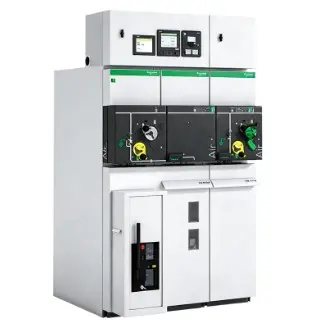
In the wave of "defluorination" in power equipment, replacing sulfur hexafluoride (SF₆) with dry air or nitrogen (N₂) is not a simple "gas swap," but a huge game of physical properties.
The most core difference lies in arc-quenching capability. SF₆ possesses extremely strong electronegativity and can efficiently capture electrons; its arc-quenching ability is about 100 times that of air. In contrast, dry air and nitrogen have stable molecular structures and basically lack effective arc-quenching performance. If traditional switchgear designs were used, the arc would fail to extinguish, leading to equipment burnout or even explosion.
Facing this physical chasm, the industry has explored a set of effective solutions through the reconstruction of technical routes.
1. Core Contradiction: From "Active Suppression" to "Passive Endurance"
In SF₆ circuit breakers, the gas wears two hats: it acts as both the insulation medium and the arc-quenching medium. When contacts separate and an arc is generated, the SF₆ gas flow forces the arc to extinguish.
However, dry air and nitrogen face physical limitations:
Simply put, SF₆ actively "strangles" the arc, while dry air/nitrogen can only passively "endure" it. Therefore, the strategy must change: let the gas be responsible only for insulation, and introduce other media to handle arc quenching.
2. Breaking the Deadlock: Three Major Engineering Strategies
To address these challenges, mainstream solutions adopt a "hybrid technical route"—a combination of vacuum arc quenching + gas insulation—supplemented by precision structural design.
Functional Decoupling: The Core Intervention of Vacuum Interrupters
This is the fundamental solution to the weak arc-quenching capability of dry air/nitrogen. Since air cannot extinguish arcs effectively, we introduce a perfect "outsider" in this field—the vacuum.
Mechanical "Precision Braking": Puffer-Type Stagnation Point Design
Although vacuum is mainly used for arc quenching, arcs may still occur when disconnectors break small currents (e.g., capacitive currents) or when acting as load switches. At this point, how to utilize the weak air flow field to assist in arc extinction becomes key. Manufacturers like ABB have innovatively applied "puffer-type" technology.
Coordination Optimization of Grounding Safety and Operating Mechanisms
Since dry air/nitrogen lacks the strong insulation and arc-quenching capabilities of SF₆, extreme caution is required during grounding operations.
3. Conclusion
Replacing SF₆ with dry air or nitrogen is essentially an engineering art of "maximizing strengths and avoiding weaknesses." We acknowledge and accept the reality that they are "weak" in arc-quenching capability (less than 1% of SF₆), so we no longer force them to perform the high-difficulty task of "cutting current." Instead, we position them as pure insulation barriers. By introducing vacuum arc-quenching technology, coupled with puffer-type structural optimization and intelligent control strategies, we have successfully bypassed the shortcomings of physical properties, providing a feasible path for building a green, safe, and future power grid.