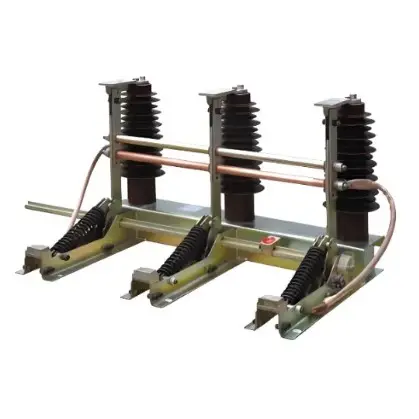
I. Systemic Risks Caused by Interlock Protection Failure of Earthing Switches
As core safety protection equipment in 10-24kV medium-voltage distribution networks, earthing switches must implement strict interlocking with circuit breakers and switchgear trolleys (trucks). Their primary function is to prevent catastrophic malfunctions such as "closing on live circuits" or "delivering power with grounding active," thereby ensuring the safety of personnel and equipment.
Core Industry Pain Points: Current challenges include flawed interlock designs and poor component quality in some products. Issues such as mechanical interlock jamming and erroneous electrical interlock signals are common. These defects can easily lead to electric shocks, arc flash injuries, and equipment explosions, representing a significant hidden danger in power grid operations.
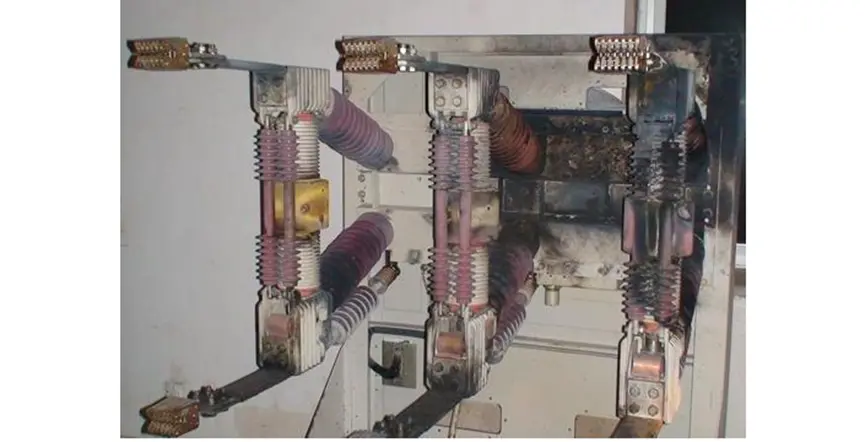
Typical Case Study: In a 24kV distribution station for a data center, a design defect in the interlock between the earthing switch and the circuit breaker, combined with undetected wear on a mechanical pin, led to a critical error. An operator mistakenly pulled out the circuit breaker trolley while it was still in the "service position." An arc was generated before the main contacts fully disengaged, releasing over 50kJ of arc energy. The resulting high temperature melted the copper contacts, and the pressure wave shattered the observation windows. This incident caused thermal injuries to two operators, triggered an insulation breakdown fire, and interrupted IT loads for 4 hours, resulting in indirect losses exceeding 20,000,000 RMB. Furthermore, widespread issues like auxiliary contact oxidation and signal transmission anomalies often lead operators to misjudge equipment status, triggering further safety accidents.
II. Triple-Shield Solution for Interlock Protection Failure
To address the pain points of interlock failure, this solution draws on advanced interlock design philosophies (such as the Schneider MVnex series) to construct a "Mechanical + Electrical + Intelligent Monitoring" triple-protection system. It eliminates hidden dangers from the perspectives of design, components, and monitoring to ensure absolute compliance with operational sequences.
Mechanical Interlocking: Physical Hard Limits for Mandatory Compliance
Utilizing a cam linkage mechanism and pin-style locking, the circuit breaker trolley and earthing switch are rigidly connected. This creates an irreversible operational logic: the earthing switch can only be closed when the trolley is in the "test" or "disconnected" position and the circuit breaker is fully tripped (open). Once the earthing switch is closed, the trolley is mechanically locked and cannot be pushed into the "service" position. Additionally, the operating handle design is optimized with a gear set linkage; the earthing switch operating rod can only be inserted and rotated after the circuit breaker's "open" signal is confirmed, providing a physical barrier to prevent malpractice.
Electrical Interlocking: Logical Blocking and Signal Verification
By collecting signals from the auxiliary contacts of both the circuit breaker and the earthing switch, a rigorous control circuit logic is established. The earthing switch closing coil is energized only when the "breaker open" and "earthing switch open" signals are simultaneously met. A 0.5-second time delay is implemented to ensure the breaker's state is stable before execution. A dual-position detection mode is adopted to collect both mechanical position and electrical status signals; any discrepancy between the two immediately triggers an alarm and blocks all operations.
Intelligent Monitoring: Visualized Status and Early Warning
High-precision sensors are deployed at interlock components and auxiliary contacts to monitor action status and contact conditions in real-time. The cabinet panel features LED indicators and mechanical position pointers to display the switching state and trolley position with an error margin of $\le \pm 2^\circ$. Equipped with a diagnostic module, the system triggers a buzzer alarm if jamming, oxidation, or signal anomalies are detected. It automatically records an operation log (storing the last 100 operations) for easy troubleshooting and traceability.
Quality Control: Eliminating Component Failure at the Source
Core interlock components (pins, cams, auxiliary contacts) are made of stainless steel with anti-corrosion and wear-resistant surface treatments to extend service life. All interlock devices undergo over 1,000 reciprocating operation tests before leaving the factory to ensure flexibility and signal stability, strictly complying with IEC 60298 and GB/T 11022 standards.
III. Safety and Operational Assurance Results
Implementing this solution thoroughly resolves core issues such as interlock jamming, signal errors, and operational mistakes, achieving 100% reliability in interlock actions. Based on experience from similar data center and substation retrofits, no interlock-related safety accidents occurred during post-upgrade operations. The risk of operator error was reduced to zero, and several hidden faults in interlock components were identified and resolved early through intelligent monitoring. This effectively secures power distribution equipment and personnel, significantly reducing economic losses caused by interlock failures.