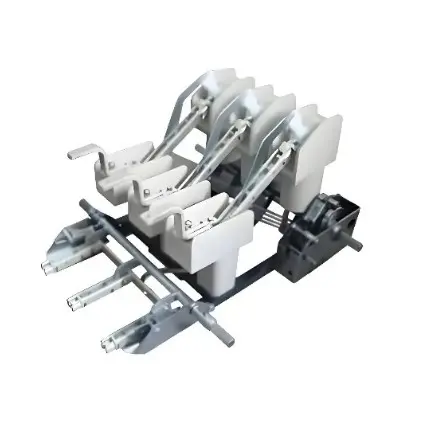
As core control equipment in medium-voltage distribution networks, Vacuum Load Break Switches (LBS) are widely used in industrial plants, commercial buildings, residential areas, and substation branch circuits. They bear the critical responsibilities of load current breaking, overload protection, and fault isolation. The management quality of each stage in their full lifecycle—Design & Selection, Manufacturing, Installation & Commissioning, Operation & Maintenance (O&M), and Decommissioning—directly determines operational reliability, service life, and costs.
Currently, the industry suffers from "prioritizing production over lifecycle management," leading to pain points such as inherent maladaptation, latent defects, low O&M efficiency, and non-standard disposal. These issues frequently trigger power interruptions and safety hazards. This solution establishes an integrated management framework to ensure high efficiency, safety, and low-cost operation from selection to retirement.
I. Pain Point Focus: Evidence of the "Five-Link" Weaknesses
1. Design & Selection: Inherent Maladaptation
Core Pain Point: Failure to customize designs for specific scenarios (coastal, high-altitude, industrial) leads to unreasonable component selection, resulting in flashovers or mechanism jamming later.
Evidence: A rural grid at 3,500m altitude used standard switches; low air pressure caused insulation failure, leading to 4 faults in six months and 150,000 RMB in extra replacement costs.
2. Manufacturing: Latent Defects from Lax Control
Core Pain Point: Using inferior materials (standard epoxy, low-cost interrupters) and substandard welding or sealing processes leaves "hidden killers" like insufficient vacuum or contact resistance.
Evidence: An industrial park used low-cost switches with standard ceramic interrupters. Two years later, a vacuum failure caused a persistent arc, resulting in a 6-hour outage for 3 production lines and 400,000 RMB in losses.
3. Installation & Commissioning: Non-standard Operations
Core Pain Point: Lack of professional skills leads to improper bolt torque or imprecise mechanism adjustment, causing overheating or jamming immediately after commissioning.
Evidence: A commercial building's switches had improper contact pressure at installation. Three years later, temperature rise hit 90K (standard $\le$ 75K), requiring urgent maintenance costing 20,000 RMB.
4. Operation & Maintenance: Crude Manual Modes
Core Pain Point: Reliance on manual inspection makes it hard to detect vacuum decay or internal aging. Small risks escalate into major failures due to a lack of intelligent monitoring.
Evidence: A residential cabinet suffered a short circuit because a spring mechanism jammed due to lack of lubrication, causing a 4-hour blackout for an entire building.
5. Decommissioning: Irregular Disposal Hazards
Core Pain Point: Non-standard dismantling creates environmental pollution (leaking interrupters) and safety risks (electric shock or falling parts).
Evidence: Many retired interrupters are discarded improperly, wasting resources and polluting the environment due to a lack of professional recycling.
II. Five-Link Synergy: Full-Process Optimization
1. Design & Selection: Customized Adaptation
Scenario-Specific Selection: Industrial (anti-corrosion/overload), Coastal (salt-spray sealing), High-Altitude (insulation/heat dissipation reinforcement), and Civil (modular/compact).
Premium Components: APG cast resin insulation, high-performance ceramic interrupters ($\ge 10^{-4}$ Pa), and silver-plated CuCr contacts.
2. Manufacturing: Quality Stringency
Material Control: Specialized testing for all core parts; zero tolerance for substandard components.
Process Optimization: Integral APG casting to eliminate air gaps; CNC machining for contact precision; and mandatory 10,000-cycle mechanical endurance tests.
3. Installation & Commissioning: Standardized Delivery
Precision Installation: Use of torque wrenches and specific sealants; strict adherence to cleaning protocols for sealing surfaces.
Verification: Mandatory contact pressure and travel distance adjustments; multi-cycle trial operations before grid connection.
4. Operation & Maintenance: Intelligent Management
Smart Monitoring: Deployment of sensors for temperature, vacuum, and insulation status with real-time cloud data transmission.
Predictive Maintenance: Algorithms to predict aging and trigger alerts 7 days in advance; 30-minute quick-replacement mechanism for wear parts.
5. Decommissioning: Green & Safe Recovery
Professional Dismantling: Safe vacuum release before dismantling; classified recycling for metals and insulation materials to achieve 90%+ resource recovery.
III. Empirical Results: 90% Lower Failure Rate
Based on an industrial park implementation:
Reliability: Failure rate ↓90%; Power reliability ↑99.97%.
Cost: O&M costs ↓60%; Service life extended from 5 years to 10+ years.
Environment: 95% recovery rate for retired components; zero environmental pollution.
IV. The Four Guarantees
Technical: Expert team support based on IEC 62271-102 and GB/T 14808 standards.
Quality: Checkpoints at every link; 1-year free warranty and lifetime maintenance.
Training: Specialized certification for installation and O&M personnel.
Spare Parts: Dedicated inventory for interrupters, contacts, and seals for rapid response.
V. Conclusion
The stable operation of Vacuum LBS requires synergistic control across the entire lifecycle. By addressing maladaptation, latent defects, and crude maintenance, this solution builds a safe foundation for medium-voltage networks and facilitates the transition toward smarter, greener power systems.